Craft · 組子

Interlocking strips, not a printed lattice.組子

Kumiko is a method of assembling thin wooden pieces into a geometric lattice. In traditional work the pieces are grooved, fitted, and held by pressure and joinery. Nails are not part of the definition. Glue is a modern convenience, not the historical rule.

The word 組子 compounds 組 (kumi, to assemble or set in order) and 子 (here a diminutive for small members). In tategu — the trade of architectural fittings — kumiko are the slender muntins that fill a frame. English usage has widened the word to mean the whole decorative lattice, and then the craft of making it.

Wikipedia’s short article, drawing on trade sources, describes thinly slit pieces that are grooved, punched, and mortised, then fitted with plane, saw, and chisel. Panels “slot together and remain in place through pressure alone.” That interlocking-strip method is kumiko. A graphic of the same pattern, cut from a sheet, is a different object. See Hand vs CNC vs laser.

Rice glue and paper are ordinary in shōji covering. The lattice members interlock; they are not nailed through like a Western grill.
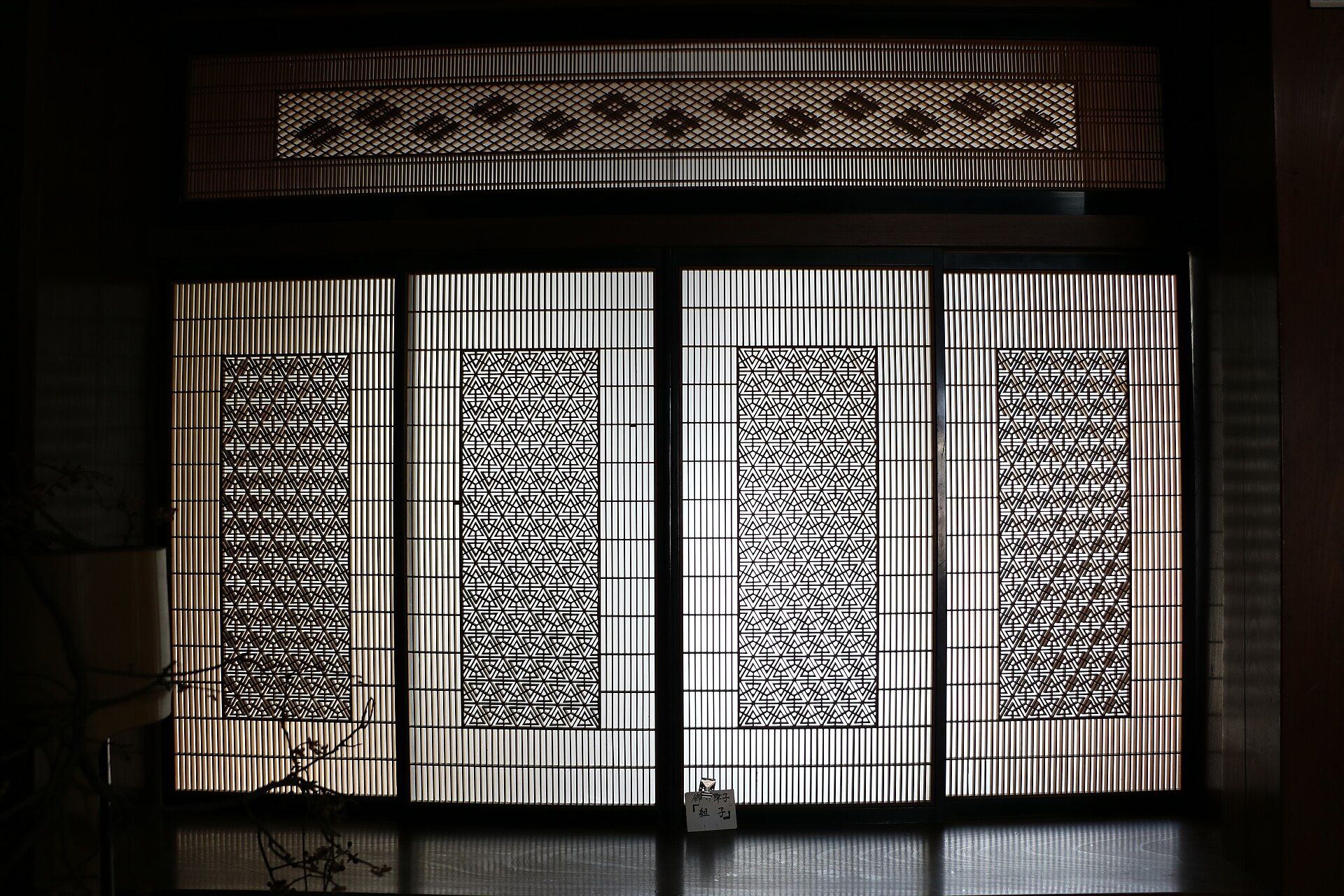
Kumiko lattice in the guest room of the former Nishina house, Tsuru, made around 1921
Kumiko-zaiku in the guest room of the former Nishina house, Tsuru City Merchant Museum. Panel dated around 1921. Photo さかおり, CC BY-SA 4.0.

Where it sits

Shōji, ranma, and the tategu trade.

In historical practice kumiko is a filling for fittings: sliding screens, transoms, and movable partitions in a Japanese room.

障子

Shōji

Translucent sliding screens: a wooden frame, a lattice of kumiko, and washi on the exterior face. Edward S. Morse, writing in 1886, already described the “light frame-work made of thin bars of wood crossing and matched into each other.” Decorative fillings occupy bands, hip-boards, or the whole field.

欄間

Ranma

The transom above fusuma or shōji, between the kamoi lintel and the ceiling. Ranma may be open lattice, carved wood, or mixed. Toshio Odate’s Making Shoji (2000) includes an asanoha transom as a worked example — a documented teaching project.

建具

Tategu

The broader trade: doors, screens, transoms, and the carpenters (tategu-shi) who make and fit them. The Takenaka Carpentry Tools Museum (Kobe) files kumiko under tategu: muntins combined into a continuous surface for shōji, ranma, or tsuitate.

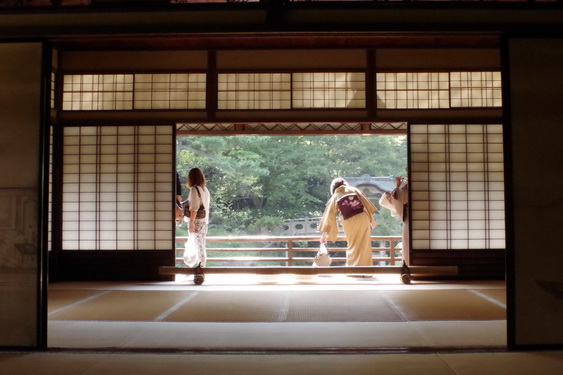
Paper-covered shōji at Rinshunkaku, Sankei-en, Yokohama
Shōji at Rinshunkaku, Sankei-en, Yokohama. Building history is disputed (once linked to Jurakudai; now more often to a Kishū Tokugawa villa). Photo Ktmchi, CC BY-SA 4.0.
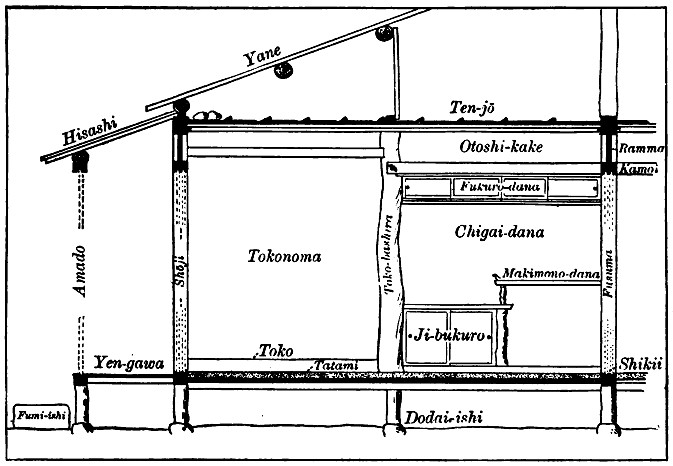
Edward Morse 1885 section through verandah and guest-room showing shōji and fusuma grooves
Morse, Japanese Homes and Their Surroundings (1885), fig. 103: section through verandah and guest-room. Public domain.

How a panel is built

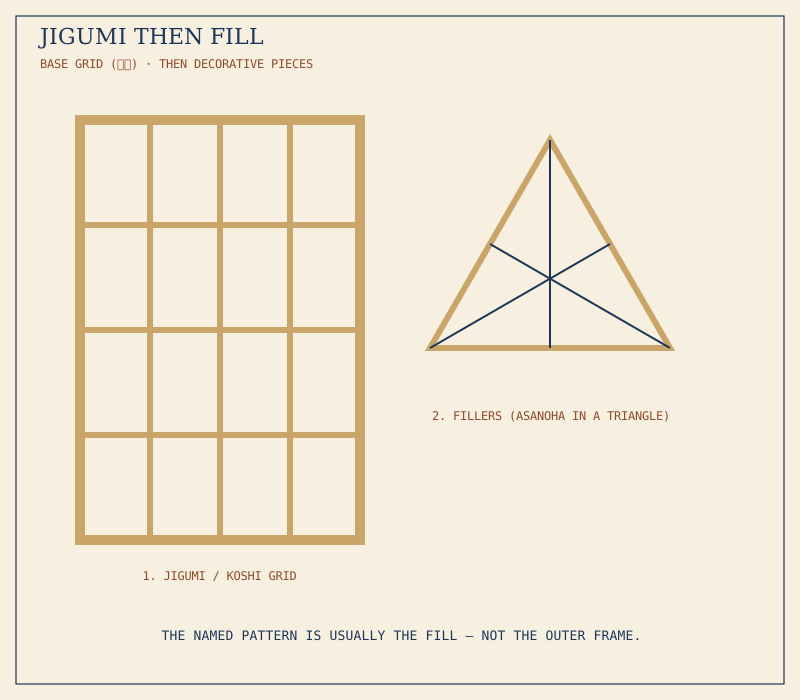
Jigumi first, then the named filling.

English-language shop books (Desmond King; Matt Kenney; Odate) agree on the order even when they disagree on jigs.

Diagram showing a square kumiko grid beside a triangular cell with asanoha fillers
Original plate: base grid, then fillers. CC0.
  1. Frame. Stiles and rails, typically mortise-and-tenon, sized to the opening (shōji grooves in the kamoi and shikii are a separate fitting problem).
  2. Jigumi (地組). The base lattice — square, diamond, or triangular/hexagonal — assembled from grooved strips. This is structure. Mitsukude lives here on the 60° side.
  3. Fillers. The named pattern: asanoha pieces, goma pieces, shippō circles approximated in wood, and so on. These are cut to angles (30°, 60°, 22.5°, 45°…) and tapped in.
  4. Paper, or not. Shōji takes washi. A ranma or a furniture panel may be left open. Openwork is still kumiko if it is still strips.

Pitch (the spacing of the jigumi) changes both look and cost. Yoshihara Woodworks states this in catalog notes: finer pitch is more pieces, more time, more money.

Dates, which do not agree

Dates that do not agree.

Sources disagree on the origin century.

Trade copy

Asuka, 6th–7th c.

Tanihata Co. (Toyama) and pages that quote Tanihata, including the English Wikipedia stub, place the technique in the Asuka era, with Buddhism, Baekje artisans, and temple building — a company-history dating.

Museum label

Kamakura, said to

Takenaka Carpentry Tools Museum: kumiko’s “origin is said to date back to the Kamakura period.” The same label notes further development in the latter half of the Shōwa period — i.e., the fine commercial craft is partly modern.

Regional notes

Tools, then density

JTCO’s Ōkawa kumiko note points at Hōryū-ji balustrade lattice as an early assembled pattern, then argues that the intricate work seen today follows later saws (from the 15th c.) and planes (jointing planes around the 17th c.). Sashikan in Mie associates development with Muromachi shoin-zukuri. These are compatible with “lattice is old; this density is later.”

Named fillings in the numbers quoted by catalogs (“nearly 200 patterns,” “since the Edo era”) are Edo-and-after workshop vocabulary — a statement about naming and surviving practice.

Suzuki Harunobu print of a woman beside an open shōji
Suzuki Harunobu, The Shōji Screen, c. 1766. Public domain. The screen as a room element.

Morse is still the most useful English eyewitness for ordinary fittings. He distinguishes fusuma (opaque papered partitions) from shōji (exterior, papered on one face, admitting light). He notes accidental holes patched with cut blossoms rather than squares — a paper habit, not a kumiko one. He is a source for the room.

For the craft as taught to outsiders in the last fifty years, start with Toshio Odate (apprenticed as a tategu-shi) and with Desmond King (trained in tategu at Shokugei Gakuin, Toyama, 2008–09). See Sources.