Jigumi · 地組
Two grids.
Kumiko is often introduced as “all 60°.” That is the mitsukude family, and it is the family of asanoha and kikkō. It is not the whole craft. Square jigumi — 90°, with 45° diagonals — carries izutsu, masu, kaku-asanoha, and the goshi lattices of ordinary shōji.
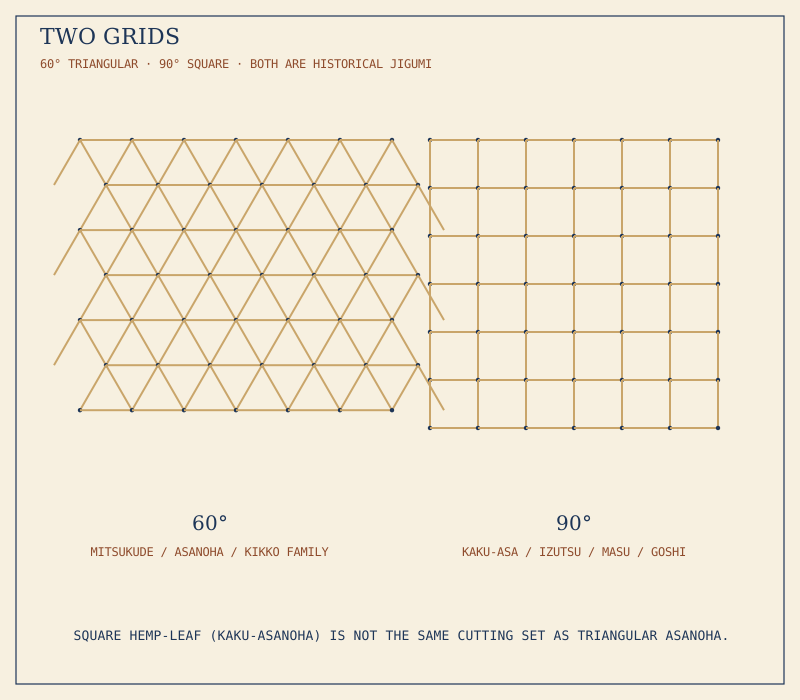
60° — triangular / hexagonal
Three directions of strip, 60° apart. Nodes are mitsukude. The visible cells are equilateral triangles or, dually, hexagons. This is Yoshihara’s kikkō-gumi. Fillings: asanoha, kagome, goma, many kikkō variants. Typical cutting angles for fillers: 30° and 60° (King’s triangular asanoha note).
Hexagons and triangles are the same lattice seen two ways. Mitsukude members run along triangle edges; hexes appear as the voids. “Hexagonal kumiko” names the voids unless the members themselves follow the hex edges.
90° — square / diamond
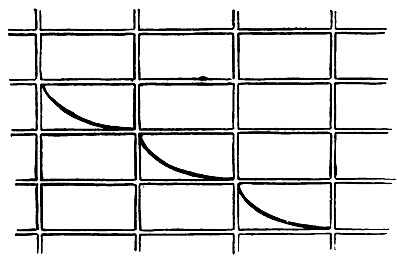
Two directions, plus optional 45° diagonals. This is ordinary shōji kumiko (the rectangular grating Morse drew) and Yoshihara’s masugata-gumi. Fillings: kaku-asanoha, izutsu, masu-tsunagi, shokko, and the various goshi (lattice) types: senbon-goshi, nawame, naname-goshi.
Beginner Western kumiko is often square because a 45° shooting board is already in the shop. Square grids are historical. They are also the easy on-ramp.
A short angle table
| Work | Jigumi | Typical filler angles | Source of the note |
|---|---|---|---|
| Plain shōji grating | 90° | none (grid only) | Morse 1886; Odate Making Shoji |
| Asanoha (triangular) | 60° | 30° / 60° | King, triangular-grid asanoha |
| Kaku-asanoha | 90° | 45° / 22.5° / 67.5° | King / shop-jig writers |
| Mitsukude field | 60° | node at 60° | Yoshihara; Tanihata |
| Izutsu-tsugi | 90° | 45° corners | King (square beginner pattern) |
| Shippō (circles) | special | many short facets | Tanihata: “cannot be adjusted” in their pitch system |
Angles above are workshop-book figures, not a survey of every historical panel. A given shop’s kanna and jigs will shift the numbers.
Pitch — the center-to-center spacing of jigumi — is a design number and a cost number. Yoshihara says so in catalog copy. King spends pages on calculating pitch from opening width and mitsuke (the visible face width of a strip). Odate’s asanoha transom is a worked dimensioned project. If a laser file has no pitch, it is a picture.
Diamond (hishi) grids are a third family: 60° or other rhombi, catalogued separately by Yoshihara. The name is noted; the cutting set is left to the catalogs.