Pattern · 麻の葉
Asanoha麻の葉
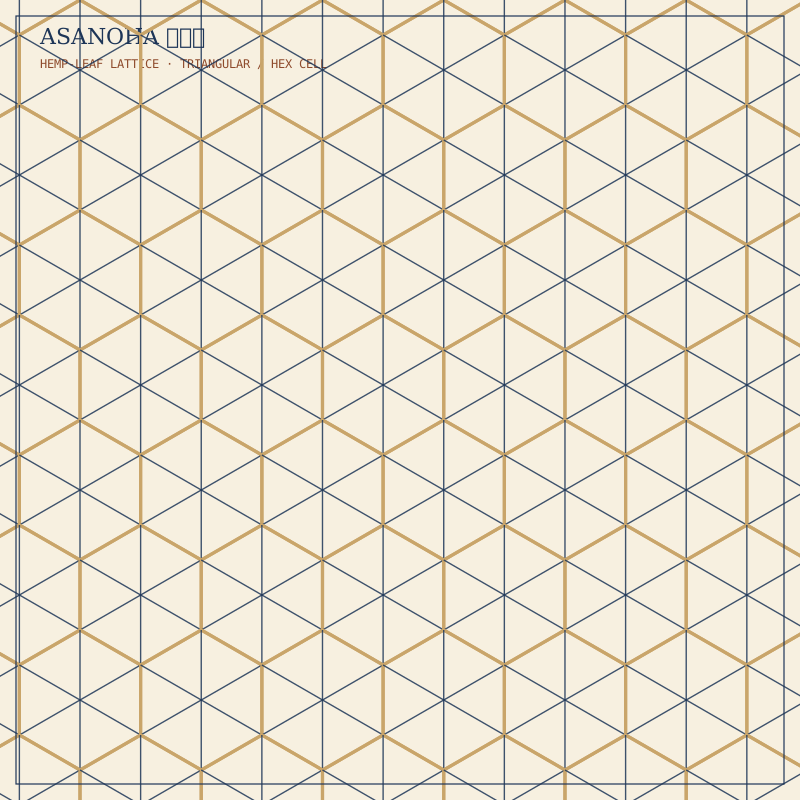
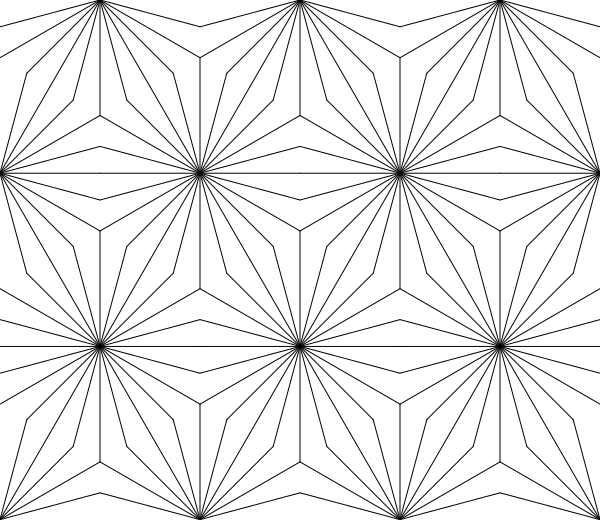
“Hemp leaf.” A filling that reads as a six-pointed star inside a hexagonal cell — or, on a square jigumi, as kaku-asanoha with a different angle set. English-language shop books teach it first.
The motif is older than any kumiko catalog on Sources: asanoha is a standard wagara (traditional pattern) on textiles, stencils, and crests. Life of Riley’s public-domain kirikane drawing on Commons is the same geometry used in decorative arts generally.
In kumiko, asanoha is a filling. On a triangular jigumi the cell is an equilateral triangle; three pieces meet toward the center. Six such triangles around a point make the hemp-leaf hex. Desmond King describes this triangular-grid asanoha as comparatively economical: one 30° setting and one 60° setting, three fillers per triangle.
Kaku-asanoha (角麻の葉, “square hemp-leaf”) lives on a 90° grid. King and other shop writers note three different filler shapes and angles of 45°, 22.5°, and 67.5°. It looks related. It is not the same rod of wood and not the same jig.
Dates, lore, and the sourced trail
The kumiko filling is not dated to the Heian period by a cited primary object. Japan Objects and Tanihata marketing pages that repeat early dates do not cite one. Hemp grows fast; Edo textile commentary associated asanoha with children’s clothing — wagara lore, widely repeated. Published sources do not attach a named temple carpenter to the filling.
Odate teaches an asanoha transom in Making Shoji (Linden, 2000). King teaches multiple methods for asa-no-ha in Shoji and Kumiko Design, Book 1 and in the Complete Guide series. Tanihata and Yoshihara sell it as a standard.
Laser / CNC note
The hemp leaf is easy to fake as a graphic.
Because asanoha is a tessellation of straight lines, it is a favorite of laser files. A kerf through plywood can look “Japanese” at two meters. It still has no strips and no joints. See the translation notes.